
Remembering Tiwana Sahib & The Caste-Roots of Punjab Partition
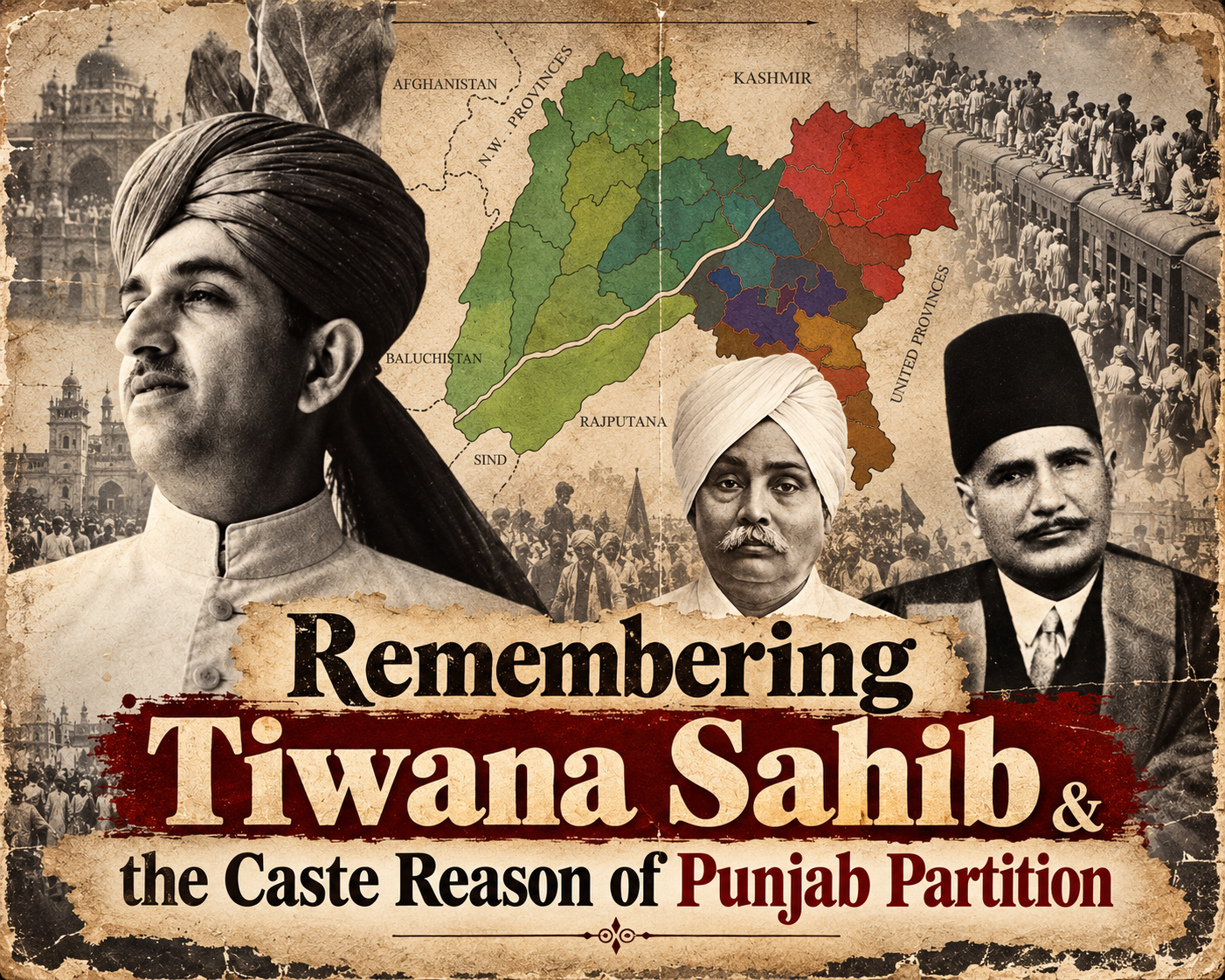
Malik Khizr Hayat Tiwana of Shahpur, Punjab, was a Parmar Rajput. His ancestral village was Meetha-Tiwana. He was a leader of the Punjab Unionist Party and remained opposed to the Partition of India and the Muslim League until the end. His ancestors are said to trace their lineage to Raja Randhol Parmar, who was the brother of Raja Jagdev Parmar and the son of Udayaditya Parmar. Udayaditya Parmar was the brother of the Parmar emperor Bhoj.
Today, some Hindus belonging to the Jat community in India are determined to claim him as one of their own, whereas many of our Hindu Punjabi-Rajput friends living in the UK have direct contact with his family.
Jinnah, who came from the Lohana community (the same community as Lal Krishna Advani), and the Muslim League launched a movement against the Punjab Unionist Party in 1946, creating a communal atmosphere in Punjab that ultimately brought down the Tiwana government. Otherwise, before this, Punjab was neither a strong supporter of the Muslim League nor of Partition. Across India, the strongest support for Partition came from Bengali Muslims and Muslims from the United Provinces and Bihar, followed by Muslims of southern India—particularly from regions where Muslim landed elites had Arab, Turkic, or Mughal family backgrounds. However, in Punjab, the demand for Partition was initially raised by Hindu Khatris (Lalas), among whom Lala Lajpat Rai was a prominent figure.
When Jinnah was propagating the Two-Nation Theory, Tiwana Sahib pointed out that members of his own lineage were also Hindus and Sikhs. He therefore questioned how Jinnah could claim that he and the Hindu and Sikh members of his own lineage constituted separate nations.
There was neither a Kshatriya leader nor a leader from the peasant communities behind the Partition of India. Rather, the driving forces behind it were the urban upper-caste social groups among both Hindus and Muslims.
Punjab had a larger Rajput population than Rajasthan and Gujarat, and around 75% of Punjab’s Rajputs were Muslims. Therefore, one consequence of the Partition of Punjab was that approximately 70% of the population of Punjab went to Pakistan leaving behind today’s Indian Punjab and Haryana.
The consequences can be understood in another way. From the Congress era until 2014, Punjabis had a particularly strong influence over India, although after 2014, Marathis began to challenge that dominance. Indian cinema, popular culture, Congress policies, and the bureaucracy have all historically revolved to a considerable extent around Punjab and Punjabis, and this influence continues in many respects even today.
Yet within this Punjab, Jats, Khatris, and Brahmins became dominant, while Rajputs became comparatively weaker and more isolated in relation to their population and historical influence. This was further compounded by Hindu Rajputs becoming drawn toward Hindutva—which I would characterize as a Maratha-oriented ideology—and Sikh Rajputs being drawn toward Khalistan—which I would characterize as a Jat-oriented ideology.
In other words, Congress’s Punjab-centric approach benefited Jats, Brahmins, and Khatris across the country, but did not benefit us to the same extent. On the contrary, Jats, Brahmins, and Khatris collectively shaped Congress into an ideology that remained consistently anti-Kshatriya. This began to change in Rajasthan only after the rise of Ashok Gehlot, who belongs to the Mali community among the original OBC groups.
The Partition of Punjab was therefore damaging not only to the Rajputs of Punjab but to Rajputs across India. The purpose of this post is to encourage us to begin looking at the history of the Partition of India from the perspective of our own community as well.